Be yourself; Everyone else is already taken.
— Oscar Wilde.
This is the first post on my new blog. I’m just getting this new blog going, so stay tuned for more. Subscribe below to get notified when I post new updates.
Be yourself; Everyone else is already taken.
— Oscar Wilde.
This is the first post on my new blog. I’m just getting this new blog going, so stay tuned for more. Subscribe below to get notified when I post new updates.
Introduction
Unemployment is a situation which is created in an economy when there are people who are willing to work, able to work and are ready to at the existing wage rate; yet due to certain factor or blocks in an economy are unable to do so. When these people are not able to find a job they are termed as unemployed and the event as unemployment.
India is a developing country and is on the move towards emerging as a superpower. Currently it is ranked fifth in terms of GDP at current prices according to the IMF; with a GDP of 2.97 thousand billion US $. Being so high up the ladder one would assume that India is a country with good market conditions and with sound opportunities for growth and development. However there are various things about the economy which the world does not see on first glance. The high GDP at constant prices doesn’t go in accordance with the plight of the country and the hardships its citizens face. High poverty, terrible health care, low income etc. are just few of the issues the common people have to go through.
Every 5 years a new government is formed with the two parties BJP and Congress battling it out for the centre. Each party creates a number of promises to a population of 1.3 billion people and run along the lines of meeting these promises no matter what. What them and the masses fail to realise is that this phenomenon repeats itself seasonally; every 5 years the election being the season.
Back in 2014, prior to the elections Shri Narendra Modi the current prime minister running in his second term made a number of promises and won the country as a whole. India as an economy was going through a number of issues and the then government left the population in doubt on how honest an ethical those who run the country are with the number of scams in literal terms and black money the economy had. Shri Narendra Modi then promised a lot to the people and one of the few things he promised was creating more jobs in the economy and improving the output and growth as a whole.
Any common man would easily associate the fact that a rise in employment would imply higher output, and this higher output would cause an increase in the growth and thereby its development. This can be considered as a principle of Economics 101. Today with the BJP forming the government with a consecutive clear cut majority we critically need to assess the governments performance during its last term.
Indian population
The Indian population can be divided into 4 major categories. The 0-14 age group which is the group on which the country must focus on educating them as they are the prime future of the country; the 15-24 age group or the youth, the age at which they just start earning and for some are already the bread winners at home; 24-59 age group; the already settled citizen who has some plan, earns well to live comfortably and who knows what needs to be done and finally the 60+ age group a majority of which we can consider as retired individuals and people who get pensions. In India according to the 2011 census around 30% is between the age of 0-14.
Now, coming to the issue at hand, the country has acute shortage of jobs and the market for jobs isn’t performing well. It becomes very important to analyse the cause for this. If we go back to the economics 101 principle of high employment and high jobs then we see India, a country whose GDP now is on the decline should try to increase its employment to improve its growth rates. Yet we see that there is a case of low job availability and an unemployment crisis in the country.
One critical aspect of this rising unemployment is the fact that the youth as well as a major chunk of the educated people are unemployed. As we know the youth form the base for India’s future. The education and employment opportunities of this sector of the population is highly important. Based on the NSSO reports of the 2017-2018 Unemployment Surveys the rate of unemployment among the youth between the age of 15-24 and the educated especially the educated female has risen drastically.
Unemployment
| Unemployment Rate | |||
| YEAR | 2004-2005 | 2011-2012 | 2017-2018 |
| Rural male youth | 3.9 | 5 | 17.4 |
| Rural female youth | 4.2 | 4.8 | 13.6 |
| Urban male youth | 7.5 | 8.8 | 18.7 |
| Urban female youth | 13.1 | 14.9 | 27.2 |
Source: National Sample Survey Organisation
| Educated Unemployed | |||
| YEAR | 2004-2005 | 2011-2012 | 2017-2018 |
| Educated rural males | 3.5 | 4.4 | 10.5 |
| Educated rural females | 9.7 | 15.2 | 17.3 |
| Educated urban males | 3.6 | 5.1 | 9.2 |
| Educated urban females | 10.3 | 15.6 | 19.8 |
Source: National Sample Survey Organisation
The youth, women and educated seemed to be the most affected by this unemployment crisis. 27.2% of the urban female youth and 13.6% of the female rural youth are facing unemployment. This a major sector of the country and it causes an imbalance on the economy.
The effect of unemployment is highest seen on the youth and then the educated set of the population. From the table it is evident that the percentage of unemployment has not only risen but also the total population which is unemployed is also increasing as these values are a percentage of the total youth force or population.
We see a kind of an economic paradox in India where more and higher education implies lower chances of employment. Based on data from OECD in most countries which are developed like Germany and France there exists a situation where there is very high uneducated unemployment. Data shows that the unemployment is higher among those who have not cleared secondary schooling that when compared to those who have. These countries are an example for the fact that higher education implies lower chances of being unemployed. Yet in India the exact opposite is taking place.
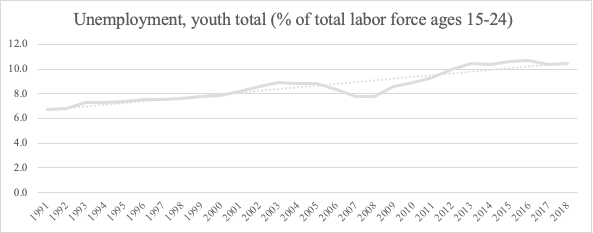
Source: https://data.worldbank.org/indicator/SL.UEM.1524.ZS
The above graph shows the trend for the unemployed youth in India as according to data from the world bank. It shows that the youth population in India has high unemployment and it is an upward trend which implies that it going to increase in the future. This isn’t a good sign for the economy. With an already increasing population and higher rates of unemployment for the youth age group it will result in a chain cycle of economic slowdown. As population rises the number of people who fall in the category of the age 0-25 rises, as rates of unemployment rise among them, the output keeps on reducing, more and more people keep getting added due to growth in population and the output keeps on declining due to lack of available options to integrate them into the workforce.
Causes for unemployment
It is important to realise the causes for this high unemployment. Factors like increasing population, rise in the number of people in the workforce and shortage of jobs are just common reasons. Other than these there are a number of reasons which can be related to unemployment in India.
This cause is for both youth as well as educated unemployment. In India there is a high demand by companies for skilled labour. The lack of skill is one of the reasons why the growth is so slow. Considering this there is still an issue with educated students not finding jobs. The education system in India needs to be revised so that it becomes more skill friendly and practical based rather than the present theory and solely academic based system.
Today with the world facing a huge tech boost machines and older technologies get replaced every 4-5 years. The result is that the skills required to operate these machines keep on changing and the employees face issues. Along with this India is a labour surplus economy; its growth has now deviated from being labour based to capital based.
It is estimated that in India roughly around 4.75 million people join the workforce every year. This is an average from data collected after 2012. This is a big number. The cause for low job creation is that there are many economic slumps. The lack of investment and low growth has just resulted in the creation of a number of jobs much lesser that what is required to absorb those 4.75 million people per year.
When a developing country gets an in surge of capital and resources it experiences a high growth rate; but as the country experiences this phenomena over a period of time for around 20 years the growth rate isn’t as high. In fact the country needs to focus on integrating its capital to suit the population requirement. In India today the influx of technology and capital is high but the country is not able to match the skill needed for its people to match this technology
Connection with GDP
| India’s GDP | |
| YEAR | GDP |
| 2014 | 7.41 |
| 2015 | 8.00 |
| 2016 | 8.17 |
| 2017 | 7.17 |
| 2018 | 6.98 |
Source: https://data.worldbank.org/indicator/NY.GDP.MKTP.KD.ZG?locations=IN
This shows the GDP for the last five fiscal years in India. It is evident from this table that the economy has slipped into a 5 year low; for the first time it has fallen below 7% since 2014. It lost its position as the fastest growing major economy to China post this release of data by the government.
The release of this data was under high scrutiny as India’s post Chief Economic advisor, Arvind Subramanian said that the government may have boosted the figures by around 2.5%.(GDP growth overstimated during 2011-12 and 2016-17: Arvind Subramanian, 2019)
Based on Okun’s law there exists a relationship between a countries employment opportunities and its subsequent growth. The law is focussed on generating an explanation of how a drop in a countries GDP is seen with a rise in unemployment. Using this law we see that a deviation caused by unemployment from its normal levels can in turn cause changes in the GDP.
The low growth was on account of the low performance of the agricultural and manufacturing sectors. Due to their underperformance and low output for the year 2017-18 the GDP was low. The other cause for this was the performance of the non-banking financial sector and the slow economic growth on account of low domestic consumption and the international trade wars.
A certain level of this low output in the economy can be attributed to the high unemployment. With more people losing jobs the output remained low. As more people were unable to work the overall spending in the economy dropped. This low spending causes a lesser aggregate demand and domestic consumption drops. There was also a low demand for goods from abroad. This coupled with the fact that now there are trade wars in international trade especially with USA and China two of our leading trading partners the growth slumped.
Hence a certain level of drop in the GDP can be associated with the unemployment in the economy.
Consequence
The first consequence is the affect unemployment has on the GDP of the economy. With lesser jobs available the output is affected and hence a drop in the GDP. The lower the chances a person of getting a job the lower is his will to get a job. For example now when people who just come out of graduation realise that the job availability is low they tend to put in lesser efforts while searching. This means a lot of jobs which may have otherwise suited them are lost in the process and a cycle of no jobs and low will to search is created.
Unemployment also creates a situation where those who are and who have the chance of being educated choose not to do so because of how the chances of finding a job post this education are lower. People find the trade-off of working immediately rather than after education a better one in such a situation. What this does is it reduces the already very low literacy rate of India.
It affects the rate at which people are willing to work at, as people find that the chances of them getting a job are low it creates two opposite situations; one in which people are willing to work at a much lower rate than what a balanced market would offer them based on their skills and two, where few people would want a higher wage considering that in the future the chances of them getting a job are lesser. This in turn affects the wage market and while one situation does mean that a company can hire more at a cheaper wage and thus increase output, the second causes them to hire lesser at a higher wage and as people keep on seeking higher paying jobs the unemployment rate rises with no jobs available to meet their terms.
Conclusion
India is reaching the stage where it is now one of the biggest economies in the world. From 1990 to today it has faced several crises and at times has been on the verge of breaking down. Yet there are always changes which are brought about and the economy goes back into its path towards success.
The government has a lot to look into, be it the underperformance of its main industry the agricultural sector or the fact that its educated population is suffering from lack of jobs. Each issue has a number of solutions but needs to be implemented well and the solution must reach one and all.
Unemployment is a macroeconomic issue which every economy goes through at some point of time. It has a number of solutions like providing skill based training to suit the market, increasing investment in the private sector, matching the employment sector with the educational sector to streamline the process of finding a job etc. A government’s function at such times is to look into the root causes and try to eradicate them at the grassroot level and ensure equal opportunity to all at such a stage. The only solution to solving a macroeconomic problem of such magnitude comes when the government and the people work hand in hand and support each other to ensure success.
References
GDP growth (annual %). (n.d.). Retrieved from: https://data.worldbank.org/indicator/NY.GDP.MKTP.KD.ZG?end=2018&locations=IN&start=2014\
Jha, S. (2019, May 31). Urban unemployment rate at 9.7% in Q3CY18, reveals NSSO report. Retrieved from:
LAL, D. (1988). The Determinants of Urban Unemployment in India. Indian Economic Review, 23(1), new series, 61-81. Retrieved from:
http://www.jstor.org/stable/29793478
Online, E. (2019, June 14). GDP growth overestimated during 2011-12 and 2016-17: Arvind Subramanian. Retrieved from:
The Unemployment Paradox: Looking at Growth Without Jobs. (2018, November 28). Retrieved from:
https://www.epw.in/engage/article/unemployment-jobs-growth-india
Unemployment, youth total (% of total labor force ages 15-24) (modeled ILO estimate). (n.d.). Retrieved from:
https://data.worldbank.org/indicator/SL.UEM.1524.ZS
This is an example post, originally published as part of Blogging University. Enroll in one of our ten programs, and start your blog right.
You’re going to publish a post today. Don’t worry about how your blog looks. Don’t worry if you haven’t given it a name yet, or you’re feeling overwhelmed. Just click the “New Post” button, and tell us why you’re here.
Why do this?
The post can be short or long, a personal intro to your life or a bloggy mission statement, a manifesto for the future or a simple outline of your the types of things you hope to publish.
To help you get started, here are a few questions:
You’re not locked into any of this; one of the wonderful things about blogs is how they constantly evolve as we learn, grow, and interact with one another — but it’s good to know where and why you started, and articulating your goals may just give you a few other post ideas.
Can’t think how to get started? Just write the first thing that pops into your head. Anne Lamott, author of a book on writing we love, says that you need to give yourself permission to write a “crappy first draft”. Anne makes a great point — just start writing, and worry about editing it later.
When you’re ready to publish, give your post three to five tags that describe your blog’s focus — writing, photography, fiction, parenting, food, cars, movies, sports, whatever. These tags will help others who care about your topics find you in the Reader. Make sure one of the tags is “zerotohero,” so other new bloggers can find you, too.

 Economica